
SRO, Guardian or contracted officer:how they compare.
Florida law gives a school four lawful ways to put an armed safe-school officer on campus. This page sets them side by side: who employs the officer, what the statute requires of them, and what each one is there to do.
The four options under §1006.12
Every Florida public school, charter schools included, must have at least one armed safe-school officer on campus during school hours. Section 1006.12, Florida Statutes, lets a district or charter governing board meet that requirement with any combination of the four options below.
| School resource officer§1006.12(1) | School safety officer§1006.12(2) | School guardian§1006.12(3) | Contracted school security guard§1006.12(4) · the option DIS provides | |
|---|---|---|---|---|
| Who employs the officer | A law enforcement agency, under a cooperative agreement with the district. | A law enforcement agency or the district school board. | The school district or charter school: an employee who volunteers in addition to regular duties, or one hired specifically as a guardian. | A licensed security agency under contract to the district or the charter school governing board. |
| Sworn law enforcement | Yes. A certified law enforcement officer who keeps the powers and duties of one. | Yes. A certified law enforcement officer with arrest power on school property. | No. | No. |
| What the statute requires | Law enforcement certification, criminal background check, drug testing and a psychological evaluation. | Law enforcement certification, criminal background check, drug testing and a psychological evaluation. | Completion of the Guardian program requirements in s. 30.15(1)(k) and certification by a sheriff. | Class D and Class G licenses; 144 hours of training conducted by a sheriff under s. 30.15(1)(k)2.; a psychological evaluation; an initial drug test and random tests after it; approval by the sheriff of each county where the guard works; and training, weapon inspection and firearm qualification by a sheriff at least once a year. |
| Role on campus | Law enforcement on campus, responsible to the employing agency. | Law enforcement on school board and charter school property. | Serves in support of school-sanctioned activities. | Aids in the prevention or abatement of active assailant incidents on school premises. |
Statutes summarized for orientation; each engagement is reviewed against current law with the school's counsel. Source: section 1006.12, Florida Statutes (2025). Page last updated .
What changes when the officer is contracted from DIS
One officer, one campus
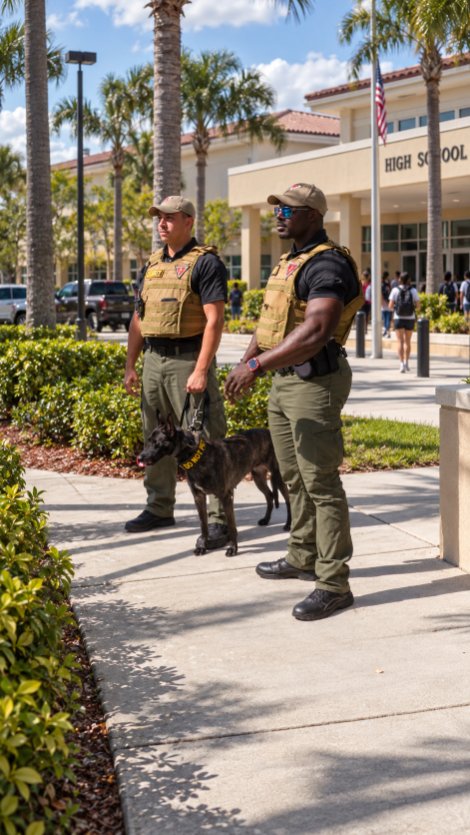
A DIS Safe School Officer is armed, full-time and dedicated to a single campus, and is introduced to the principal before day one.
No teacher or coach pulled away
A contracted officer does not take a teacher or coach away from their job the way staff-Guardian programs do.
Backfill before the bell
When an officer is absent, a certified replacement is dispatched from the regional pool before the school day starts.
Supervised from one place
Weekly regional supervisor visits and 24/7 oversight from the Command & Control Center.
Outside Florida
- Texas: every board must keep at least one armed security officer on each campus; a licensed security company may supply them.
- Arkansas: Commissioned School Security Officers are commissioned through the Arkansas State Police.
- South Carolina: SLED-registered armed security personnel work alongside school resource officers, never instead of them.
- Virginia: a dedicated School Security Officer certification through the Department of Criminal Justice Services.
Straight answers
What is the difference between a school resource officer and a school guardian in Florida?
Can a Florida school use a private security company to meet the safe-school officer requirement?
What training does a contracted school security guard need in Florida?
Which of the four options does DIS provide?
Can a school combine the options?
Do other states use the same options?
How much does a contracted school security officer cost in Florida?
Every state writes the law differently
Not sure which option fits your campuses?
A regional manager, not a salesperson, will call you within one business day.